 Web App Development
  Cloud App Development
  Front-End Development
  Cross Platform Development
  MVP Development
  Application Modernization
  PWA Development
  SaaS Application Development
  Software Development Outsourcing
  Offshore Custom Software Development
  Full Stack Software Development
  Custom Software Development
  Enterprise Software Development
  Cloud Computing Solutions
  Cloud Development
  Managed Cloud Services
  Cloud Native Development
  AI Consulting
  Machine Learning Development
  LLM Development
  AI Chatbot Development
  Data Analytics
  CI CD Development
  Digital Transformation
  Dev Ops
  Content Development
  Blockchain Development
  Web Development
  Web Design


 Generative AI
  Large Language Model
  AI Chatbot
  AngularJs
  ReactJS
  Dotnet Core
  Android
  iPhone
  Swift
Swift  E-Commerce
  NopCommerce
  BigCommerce
  Laravel
  Yii
Yii  AWS
AWS  Google Cloud
  Azure DevOps
  Automation Testing
  Security Testing
  API Testing
  Functional Testing
  MEAN Stack
  MERN Stack
  Full Stack Developers
  biz.encodedots
  biz@encodedots.com
  +91 99747 42737


- How Much Does an eCommerce App Cost in 2026?
- What Affects eCommerce App Development Cost?
- eCommerce App Cost by Type
- Where Does the Development Budget Go?
- Shopify, Headless, or Custom: Which Approach Costs Less?
- How Much Does an eCommerce App Cost in India?
- What Does an eCommerce App Cost After Launch?
- 3-Year Total Cost of Ownership: an Illustrative Example
- When Should You Build an eCommerce App?
- How to Compare eCommerce App Development Quotes
- How to Reduce Development Cost Without Cutting Corners
- Conclusion
- Frequently Asked Questions
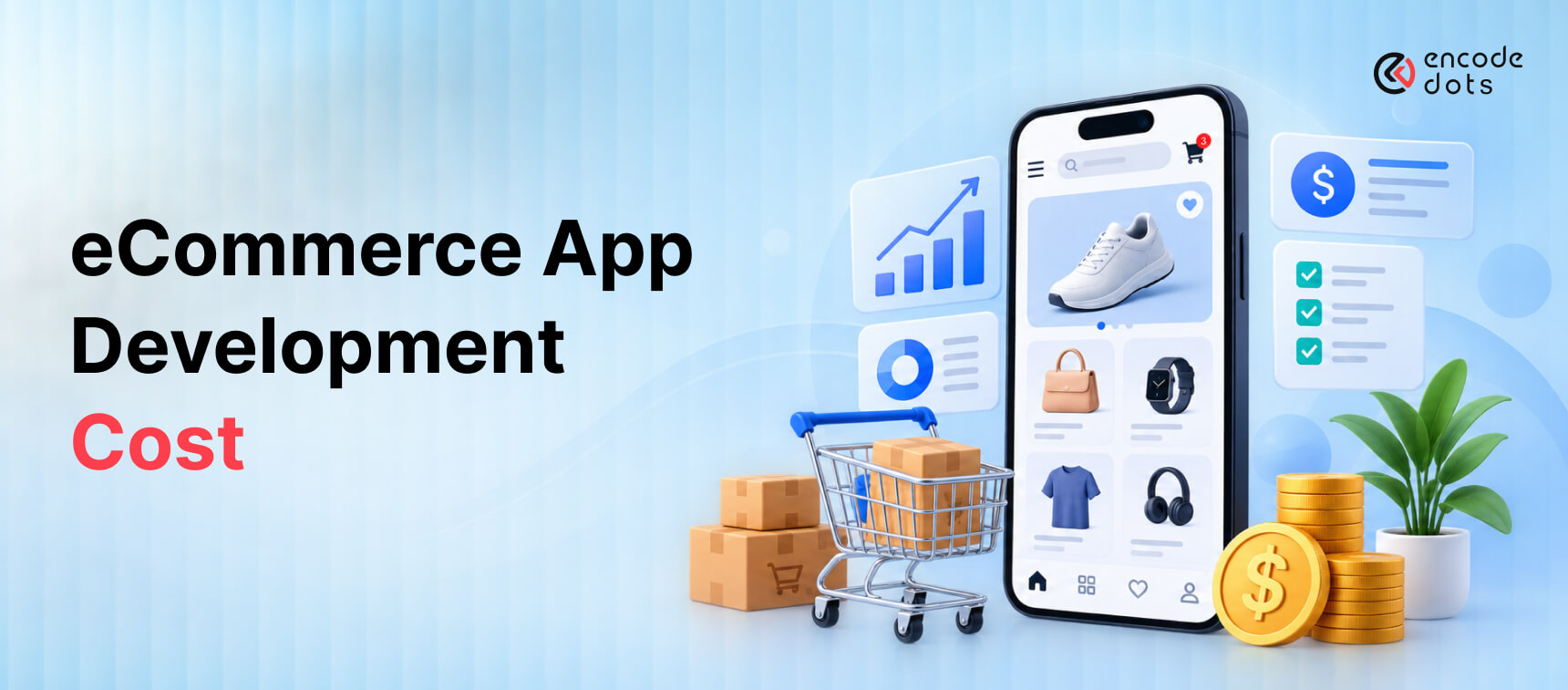
Ask five agencies about eCommerce app development costs, and you may get five numbers, some ten times apart. Nobody is necessarily wrong. “An eCommerce app” can mean a branded shopping app on top of your existing Shopify store, or a multi-vendor marketplace with its own payments, payouts, and logistics.
This guide breaks the cost into the parts you control: what you build, how you build it, who builds it, and what it costs to run for three years. You’ll also find a break-even check, the questions to ask vendors before you sign, and an honest look at when an app isn’t worth building yet.
How Much Does an eCommerce App Cost in 2026?
Quick answer
As a practical 2026 budgeting range, a professionally built eCommerce app may cost roughly $25,000 to $150,000, depending on scope, integrations, platforms, team location, and complexity. A lean MVP can start around $15,000 to $35,000. Marketplaces and enterprise platforms often exceed $150,000. Plan for ongoing costs too, commonly 15–25% of the build cost per year.
Pricing methodology: The ranges in this guide are planning estimates based on typical project scope, development hours, team composition, and integration complexity. They are not fixed market rates. Actual quotes vary by region, technology, requirements, and vendor.
Need a more accurate number? Get an estimate based on your own features, platforms, and integrations.
What Affects eCommerce App Development Cost?
Every estimate comes down to one formula: estimated hours multiplied by the team’s blended hourly rate. A 1,000-hour build costs $45,000 at $45 an hour and $150,000 at $150 an hour. Seven factors determine the hours and the rate.
- App type. A single-brand store, a B2B ordering app, and a multi-vendor marketplace carry very different business logic. A marketplace is effectively three products: a buyer app, a seller app, and an admin system.
- Feature depth. The same feature name can hide very different work. “Order tracking” might be a simple status page or a live courier map with delivery-partner integration.
- Backend architecture. Building on an existing commerce platform costs less than writing catalogue, inventory, pricing, and order logic from scratch.
- Platform coverage. iOS only, Android only, both, or both plus a web storefront. Cross-platform frameworks such as Flutter and React Native can reduce duplicated development and maintenance work compared with separate native codebases, although the actual savings depend on the feature set.
- Integrations. Payment gateways, shipping, ERP, CRM, and marketing tools each add build and testing effort, and often a monthly fee.
- Design complexity. A clean, conversion-focused design costs less than custom animations and bespoke interactions. Checkout usability deserves investment either way.
- Team location and seniority. Rates vary widely by region. Senior engineers may finish faster than a larger junior team, so a higher rate doesn’t always mean a higher total.
In short: when two quotes differ sharply, the gap usually sits in scope interpretation and exclusions, not just hourly rates.
eCommerce App Cost by Type
The cost to build an eCommerce app depends first on its business model. These planning ranges assume an experienced agency team at blended rates of roughly $35–$90 per hour. A US-only team can land noticeably higher for the same scope.
| App type | Planning range (USD) | Typical timeline | Main cost drivers |
| App for an existing Shopify or WooCommerce store | 15,000–50,000 | 2–4 months | Reuses the store’s catalogue, inventory, and checkout via APIs |
| MVP single-brand app | 25,000–50,000 | 3–4 months | Core flows only: browse, search, cart, checkout, orders |
| Growth-stage D2C app | 50,000–120,000 | 4–7 months | Loyalty, reviews, personalization, more payment methods |
| Subscription commerce app | 40,000–130,000 | 4–7 months | Recurring billing, pause/skip, failed-payment recovery |
| B2B or wholesale ordering app | 50,000–150,000 | 4–9 months | Account pricing, credit terms, approvals, ERP sync |
| Multi-vendor marketplace | 80,000–250,000+ | 6–12 months | Seller onboarding, split payments, payouts, disputes |
| Enterprise omnichannel platform | 150,000–300,000+ | 9–15 months | Headless architecture, ERP/WMS/CRM, multi-region |
The first row is often overlooked. If you already sell on Shopify, WooCommerce, or BigCommerce, the app can act as a new storefront that reads products and places orders through the platform’s APIs, such as the Shopify Storefront API. That removes a large share of backend and admin work.
Want to know which row matches your plans? Share your feature list and get a line-by-line estimate.
Where Does the Development Budget Go?
Engineering (app plus backend) usually takes the largest share, often half or more of the budget. The table uses an illustrative $80,000 growth-stage app and shows what you should receive at each stage, which is the easiest way to judge whether a phase is priced fairly.
| Phase | Share of budget | On an $80,000 build | What you should receive |
| Discovery and planning | 5–10% | 4,000–8,000 | Prioritized feature list, user flows, integration map, firm estimate |
| UI/UX design | 10–15% | 8,000–12,000 | Clickable prototype of key flows, design system |
| App development | 25–30% | 20,000–24,000 | Working test builds every sprint |
| Backend and admin panel | 25–35% | 20,000–28,000 | APIs, database, admin for products, orders, promotions |
| Integrations | 5–15% | 4,000–12,000 | Payments, shipping, email/SMS, analytics connected and tested |
| QA and testing | 10–15% | 8,000–12,000 | Test plan, device coverage, performance and security checks |
| Launch and project management | 5–10% | 4,000–8,000 | Store submission, production setup, handover docs |
If a quote gives QA less than 10% or skips discovery, the savings often return later as bug fixes and change requests.
Features that move the budget most
- Advanced search and filters: hosted search services save build time but add a monthly fee.
- Payment integrations: each method (cards, wallets, BNPL, UPI, cash on delivery) adds testing for refunds and failures.
- Loyalty and rewards: needs clear rules for earning, expiry, and returns.
- Real-time order tracking: ranges from a status page to a live courier map.
- AI product recommendations: most useful once you have enough traffic and order history.
- Marketplace seller tools: onboarding, verification, commissions, and payouts.
- ERP or WMS integration: effort depends heavily on the quality of the system’s API.
For most eCommerce MVPs, prioritize features that affect everyday shopping behaviour, such as search, navigation, checkout, and personalization, before investing in category-specific features such as AR try-on.
Ready to put real numbers on your plan?
EncodeDots helps retailers, D2C brands, and marketplace founders scope, design, and build eCommerce apps with phase-by-phase estimates.
Book a Free ConsultationShopify, Headless, or Custom: Which Approach Costs Less?
Choose the least expensive route that supports your business rules today and won’t force a rebuild within two years. Each route shifts money between upfront build and monthly fees.
Three quick checks help you decide:
| Route | Upfront cost | Ongoing cost | Best when |
| App-builder service on Shopify or WooCommerce | Low | Monthly subscription that grows with your plan | You need an app quickly and your store works well as it is |
| Headless app on an existing commerce backend | 15,000–60,000 | Platform fees plus maintenance | You want a branded, fast app without rebuilding operations |
| Fully custom backend and app | 50,000–300,000+ | Maintenance of every layer | Marketplaces, complex B2B pricing, unusual fulfilment |
Three quick checks help you decide:
- Multiply the app-builder subscription by 36 months. If that total approaches the cost of a headless build plus maintenance, owning the app is usually the better long-term deal.
- List the rules no plugin handles. Account-specific pricing, credit terms, split payouts, or regional tax logic point toward custom.
- Check where your data must live. If the app, website, and store POS need one shared catalogue and customer record, plan a headless or custom backend from the start.
If your products, pricing, and checkout are standard, a custom backend mainly adds maintenance. That budget often works harder in design and marketing.
How Much Does an Ecommerce App Cost in India?
For Indian businesses working with domestic development teams, these are practical planning ranges for 2026:
- MVP or single-brand app: ₹5 lakh–₹12 lakh
- Growth-stage D2C app: ₹12 lakh–₹35 lakh
- Multi-vendor marketplace: ₹25 lakh–₹75 lakh+
- Enterprise platform: ₹75 lakh and above
These are planning ranges, not fixed market rates. The final cost depends on features, platforms, integrations, design requirements, and team composition. Indian apps also often need UPI, cash on delivery, and regional-language support, which add integration and testing effort.
Very low-cost quotes may indicate a template-based or white-label approach, a limited feature scope, or exclusions in areas such as QA, backend work, and post-launch support. Ask for an itemized scope before comparing prices.
What Does an eCommerce App Cost After Launch?
Budget for these recurring lines from day one. Together they often exceed the original build within a few years.
- Maintenance and OS updates: commonly 15–25% of the build cost per year for bug fixes, security patches, and yearly iOS and Android changes. This is the core of your eCommerce app maintenance cost.
- Hosting: cloud costs on AWS, Google Cloud, or Azure rise with traffic, images, and sale-day peaks.
- Payment processing: processors such as Stripe or Razorpay charge a fee per transaction that varies by country and payment method.
- Third-party tools: search, SMS/OTP, email, analytics, CRM, and support chat, each often on a monthly plan.
- App store fees: the Apple Developer Program has a yearly fee, and Google Play charges a one-time registration fee.
- Security testing: periodic penetration testing is sensible for any app that handles payments.
A note on commissions: for physical goods, app-store in-app purchase commissions generally don’t apply the way they do to digital goods and subscriptions. Payment processing fees still apply. Always check current Apple and Google Play policies for your business model and market.
Compliance items to budget for
These rules are cheaper to build in than to retrofit after a store rejection or complaint.
- PCI DSS v4.0.1: the PCI Security Standards Council set 31 March 2025 as the effective date for requirements previously marked future-dated. Using your processor’s tokenized payment components keeps raw card data off your servers and reduces scope.
- Account deletion: apps that support account creation must let users start deletion in the app (Apple), and Google Play also requires a web resource for deletion requests.
- Platform updates: Google Play requires apps to meet target API level requirements, which means recurring update work.
- Accessibility: The European Accessibility Act covers eCommerce services offered to EU consumers from 28 June 2025, with WCAG-based standards as the practical benchmark.
- Data protection: GDPR, CCPA/CPRA, and India’s Digital Personal Data Protection Act, 2023 shape consent flows and data requests.
3-Year Total Cost of Ownership: An Illustrative Example
This example shows how an $80,000 growth-stage app might add up over three years. It is illustrative, not a universal cost. Payment processing is excluded because it scales with revenue.
| Cost line | Year 1 | Year 2 | Year 3 |
| Initial build | $80,000 | — | — |
| Maintenance (20% of build) | $16,000 | $16,000 | $16,000 |
| Hosting and third-party tools (~$500/month) | $6,000 | $6,000 | $6,000 |
| New features and UX improvements (15% of build) | $12,000 | $12,000 | $12,000 |
| App store fees | ~$125 | ~$100 | ~$100 |
| Total | ~$114,100 | ~$34,100 | ~$34,100 |
Three-year total: roughly $182,300, of which the build is about 44%. For simplicity, the example assumes a full year of maintenance in year one.
The takeaway: compare vendors on what the app will cost to own, not just to build. A cheaper build with hard-to-maintain code can cost more by year three.
When Should You Build an eCommerce App?
An app tends to pay off when customers buy from you repeatedly. It struggles when purchases are rare, or most shoppers find you once through search.
Signs an app makes sense now: frequent reorders (grocery, beauty, pet supplies, fashion basics), a loyalty programme customers already use, and enough returning customers for push notifications to drive real sales.
Signs to wait: infrequent, high-ticket purchases such as furniture, most traffic arriving from Google for one-off buys, no budget to promote app installs, or product-market fit still unproven. Here, a fast mobile website or a progressive web app (PWA) is often the better first step, typically with a lower upfront cost because it runs on a web codebase and skips app-store submission.
A quick break-even check
Estimate the extra profit the app must create each month:
\text{Required monthly gross profit} = \frac{\text{build cost}}{\text{payback months}} + \text{monthly running cost}
Example: a $60,000 build, a 24-month payback target, and $3,000 per month in running costs means the app needs about $5,500 in extra gross profit each month. At a 40% gross margin, that’s roughly $13,750 in additional monthly sales.
The key word is additional. Sales that simply move from your website to the app don’t count.
How to Compare eCommerce App Development Quotes
Ask every vendor the same eight questions, then compare the answers side by side.
- How many hours is each feature estimated at, and what does “done” mean for each?
- Are UI/UX design, the admin panel, QA, and project management included?
- Which devices and OS versions will you test on?
- Who owns the source code, designs, and cloud accounts at the end?
- How are scope changes handled and priced?
- Is there a bug-fix warranty after launch, and for how long?
- Which third-party services are included, and what are their monthly fees?
- Can we see a similar eCommerce app you’ve shipped and speak with that client?
Clear answers make proposals easier to compare than the headline price alone. If you’re still validating the idea, a fixed-price MVP with a flexible second phase is often the simplest way to control risk.
How to Reduce Development Cost Without Cutting Corners
- Launch an MVP around core flows: browse, search, cart, checkout, and order history. Add loyalty and advanced personalization once real usage data comes in.
- Reuse your existing backend: if you already sell online, a headless app on that platform avoids rebuilding operations.
- Use proven services: hosted payments, push notifications (for example, Firebase Cloud Messaging), and search services usually cost less than custom builds.
- Stage integrations: connect ERP or warehouse systems when order volume justifies them, but design clean APIs so they’re easy to add.
- Be realistic about AI coding tools: they speed up routine code, but discovery, integrations, QA, and design decisions still need skilled people. Ask vendors how they use these tools and whether savings show in the quote.
Avoid trimming security, QA, or checkout usability. Those are the areas where shortcuts tend to cost the most later.
Conclusion
The real eCommerce app development cost is the build plus the years of running it. Choose the right build route, scope an MVP around the flows that make money, and compare vendors on hours, inclusions, and ownership rather than the headline number.
If your customers buy often, a well-built app can become an important channel for repeat purchases and retention. If they don’t, a fast mobile site may be the smarter first step.